

Life transformations are deliberate, identity-based changes powered by consistent daily actions that redefine who you are and how you live. The most effective personal growth does not come from willpower or quick fixes. It comes from replacing old identities with new ones, one habit at a time. Research confirms that identity shifts can begin within 4 months when you consciously align daily actions with your desired self. Meetmira was built on exactly this principle: that every person has the capacity to become a true creator of their own life by clearing the unconscious blocks that hold them back.
1. How life transformations actually work
Real change is not a single event. It is a sequence: Thought → Belief → Action → Outcome. You think something new, that thought builds a new belief, the belief drives new actions, and those actions produce new results. Most people try to skip straight to action without changing the underlying belief. That is why so many efforts stall.
Sustained transformation requires replacing old identities with new ones through daily intentional acts, not through motivation alone. Motivation fades. Identity sticks. When you see yourself as a healthy person, a disciplined professional, or a calm parent, your behavior follows that self-image automatically.

The key insight is that transformation is non-linear. You will have setbacks. The people who succeed treat those setbacks as data, not failure.
Pro Tip: Start with one small daily action that your future self would take. Do it before you feel ready. The feeling of readiness follows the action, not the other way around.
2. Shifting your identity to trigger lasting change
Identity is the engine of transformation. Before behavior changes, self-perception must change. This is the psychological mechanism behind every lasting life change, from quitting a destructive habit to building a career from scratch.
Killing off an old identity feels uncomfortable. That discomfort is the signal that real change is happening. People who successfully reinvent themselves report that the hardest part is not the new habits. It is letting go of who they used to be.
Key identity-shift practices include:
- Writing a clear description of your future self in present tense
- Auditing daily habits and removing ones that contradict your new identity
- Surrounding yourself with people who already live the life you want
- Replacing self-critical internal dialogue with identity-affirming statements
- Tracking small wins that confirm your new self-image
Cognitive identity change must be paired with functional daily habit shifts to be sustainable. Without that pairing, relapse is common. The new belief needs behavioral evidence to survive.
Pro Tip: Write "I am [your future identity]" on a card and read it every morning. This is not affirmation for its own sake. It is a daily vote for the person you are becoming.
3. Physical transformation as proof of concept
The body is the most visible arena for life change, and physical results reinforce the mental shift. One of the most documented examples: a man reduced his weight from 338 to 212 pounds and maintained that result for nearly 10 years using a MIND-focused diet and heart rate training. His resting heart rate reached 47 bpm, blood pressure settled at 112/68, and body fat dropped to 12.2%. He required no medications.
That result did not come from a crash diet. It came from a decade of consistent commitment to exercise fundamentals and dietary discipline. The physical outcome was the byproduct of an identity shift, not the goal itself.
| Factor | Approach | Result |
|---|---|---|
| Diet | MIND-focused, structured eating | Sustained fat loss, metabolic health |
| Exercise | Heart rate coaching, strength fundamentals | Resting HR 47 bpm, body fat 12.2% |
| Mindset | Identity as a healthy person | No medications, decade-long maintenance |
| Balance | Planned flexibility (cheat days) | Prevented burnout, sustained adherence |
Exercise programming built on strength fundamentals followed by varied functional training produces the most durable physical results. The body adapts to variety. Rigid programs fail because life is not rigid.
Pro Tip: Track your resting heart rate weekly. It is one of the most honest indicators of cardiovascular improvement and a concrete sign that your physical transformation is real.
4. Emotional healing as the foundation of change
Emotional baggage does not disappear when you change your diet or start a new workout program. It follows you. Unresolved guilt, shame, and toxic relationships actively undermine new habits by keeping the nervous system in a stress state that favors old behaviors.
Removing negative relationships eliminates emotional triggers more effectively than diet or exercise alone. One documented case showed that emotional eating disappeared almost entirely after a person ended a toxic relationship. The food was never the real problem. The environment was.
Strategies that support emotional healing in transformation:
- Identify and name the specific emotions tied to old habits (guilt, fear, loneliness)
- End or limit contact with relationships that reinforce your old identity
- Build a support network of people who reflect your new values
- Practice daily emotional check-ins to catch stress before it drives behavior
- Replace self-condemnation with self-compassion as a daily discipline
Releasing guilt and condemnation shifts core beliefs in ways that make dropping long-standing bad habits feel almost effortless. The shift from rule-based thinking to a grace-based belief system is one of the most underrated tools in personal growth.
5. Mental fitness techniques that lock in your new identity
Mental fitness is not a metaphor. It is a practice, and it requires the same consistency as physical training. The people who sustain new life changes are the ones who treat their mindset as something to train daily, not something to hope for.
Core mental fitness practices for transformation:
- Daily affirmations: State your new identity out loud every morning. Use present tense. "I am disciplined. I am healthy. I am at peace."
- Visualization: Spend five minutes each morning seeing yourself living your desired life in specific detail. The brain does not distinguish vividly imagined experience from real experience.
- Belief auditing: Once a week, write down one belief that is holding you back. Then write the opposite belief and three pieces of evidence that support it.
- Fear inventory: Name the specific fear blocking your next step. Fear of the unknown stops more transformations than the actual difficulty of change. Naming the fear reduces its power.
- Grace-based thinking: Replace "I failed again" with "I am learning." Shifting from performance-based acceptance to unconditional self-regard changes behavior faster than any external accountability system.
Meetmira's AI consciousness trainer is built around these exact practices, helping people identify and dissolve the unconscious blocks that keep them cycling through the same patterns.
6. Environmental design for self-improvement
Your environment is either working for your transformation or against it. Most people try to change their behavior while keeping the same surroundings, the same social circles, and the same daily triggers. That is like trying to quit smoking while keeping a pack on the kitchen counter.
True transformation often means walking away from a comfortable, familiar life into uncertainty. That is not recklessness. It is the recognition that the old environment is incompatible with the new identity. One person's five-year turnaround began the moment they left a "perfect" life that felt internally hollow.
Practical environmental changes that accelerate transformation:
- Redesign your physical space to reflect your new identity (remove junk food, add workout gear, create a reading corner)
- Change your digital environment (unfollow accounts that reinforce old patterns, follow people who model your desired life)
- Restructure your schedule so new habits have a protected time slot
- Create accountability by telling one trusted person your specific goal and check-in date
7. Recognizing the signs of a real life transformation
Most people in the middle of a transformation do not realize it is happening. They feel confused, restless, and out of place. Those feelings are not signs of failure. They are signs of growth.
Key indicators that you are undergoing genuine change:
- You feel uncomfortable with habits and relationships that used to feel normal
- You ask deeper questions about your purpose and values
- Your emotional reactions shift: less reactivity, more self-awareness
- Your priorities reorganize without you forcing them to
- You start protecting your time and energy differently
- Old friendships feel misaligned while new connections feel energizing
Transformation is non-linear and requires mental toughness combined with habit integration. The discomfort of the middle phase is the most common reason people abandon the process. Recognizing these signs as progress, not problems, is what separates people who complete their transformation from those who retreat.
Sustained change also shows up in the body. Improved sleep, more stable energy, and reduced anxiety are physical markers that the nervous system is shifting out of chronic stress. These are not side effects of transformation. They are evidence of it.
8. Avoiding the traps that derail new life transformations
The most common reason transformations fail is not lack of effort. It is misplaced effort. People focus on changing behavior without changing the belief that drives it. They rely on willpower, which is a finite resource, instead of building systems that make the new behavior automatic.
Quick fixes fail over the long term because they do not address the identity underneath the habit. Successful transformations involve consistent, decade-long commitment to fundamentals. That sounds daunting. It becomes manageable when you stop measuring success by the week and start measuring it by the direction you are moving.
Three traps to avoid:
- All-or-nothing thinking: Missing one day does not erase progress. It is one data point.
- Comparing timelines: Someone else's four-month reinvention is not your benchmark. Your transformation has its own pace.
- Waiting for certainty: Certainty never arrives before the decision. It arrives after consistent action builds confidence.
9. Building a support system for lasting change
No transformation happens in isolation. The research is consistent: people who change their social environment sustain their new habits far longer than those who try to change alone. A support system does not mean cheerleaders. It means people who hold you accountable to your stated identity, not your old one.
Ending unhealthy relationships and building supportive networks is one of the most powerful environmental levers available. This is not about cutting people off carelessly. It is about being honest about which relationships reinforce growth and which ones reinforce stagnation.
Coaching, whether human or AI-powered, accelerates this process by providing structure, reflection, and accountability outside your existing social circle. Meetmira's approach combines AI-driven mindset training with emotional healing to give people a support system that works at the level of unconscious belief, not just surface behavior.
Key takeaways
Life transformations succeed when identity change and daily habit shifts happen together, supported by emotional healing and a redesigned environment.
| Point | Details |
|---|---|
| Identity drives behavior | Change your self-perception first; behavior follows automatically from a new identity. |
| Habits must match beliefs | Cognitive shifts without daily habit changes lead to relapse within weeks. |
| Environment shapes outcomes | Removing toxic relationships and redesigning your space removes behavioral triggers. |
| Physical and mental change are linked | Sustained physical results require identity-level mindset shifts, not just discipline. |
| Discomfort signals progress | Feeling out of place in your old life is a sign of real transformation, not failure. |
What I have learned about transformation that most articles miss
The part nobody tells you about real life change is that it feels like loss before it feels like gain. You grieve the old version of yourself, the familiar patterns, the relationships that no longer fit, even the problems you used to complain about. That grief is real, and it deserves acknowledgment.
What I have found, both personally and in watching others go through this process, is that the people who complete their transformation are not the ones with the most willpower. They are the ones who stopped waiting to feel ready. They made the decision first and built the feeling of readiness through action.
The non-linear nature of transformation is also something most people are not prepared for. You will have weeks that feel like regression. You will question whether anything is actually changing. Those weeks are not evidence that you are failing. They are the integration phase, where the new identity is consolidating beneath the surface before it shows up in your results.
The most underrated tool I have seen in this process is grace. Not as a religious concept, but as a practical stance: treating yourself with the same patience you would offer a close friend who is learning something hard. Rule-based self-improvement is brittle. Grace-based growth is durable.
Start where you are. Not where you think you should be.
— A
What Meetmira offers for your personal growth
Meetmira is an AI consciousness trainer designed for people who are serious about changing from the inside out. It works at the level of unconscious belief, the layer where most self-improvement tools never reach.
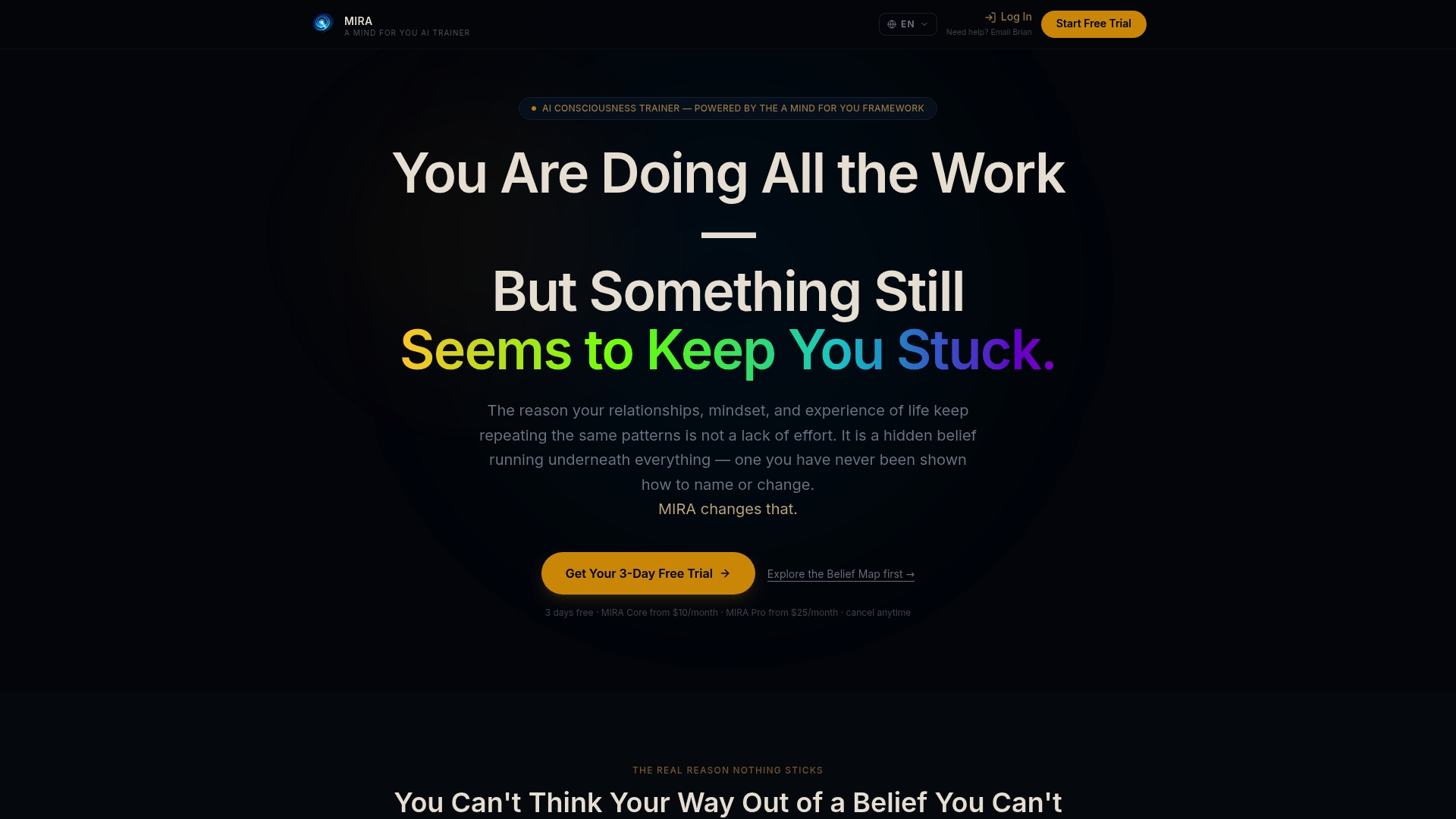
Through personalized mindset coaching, Meetmira helps you identify the specific limiting beliefs and emotional blocks that keep you cycling through the same patterns. The MIRA AI trainer guides you through daily practices that shift core beliefs, build new habits, and support emotional healing in real time. Whether you are at the beginning of a new life transformation or stuck in the middle of one, Meetmira gives you the structure and support to move forward with clarity and confidence.
FAQ
What is a life transformation?
A life transformation is a deliberate, identity-based change in how you think, behave, and relate to the world. It is sustained by daily habit shifts that align with a new self-image rather than willpower alone.
How long does a real transformation take?
Identity shifts can begin within 4 months of consistent daily action aligned with a new self. Physical and emotional results often consolidate over years, not weeks.
Why do most self-improvement efforts fail?
Most efforts fail because they target behavior without changing the underlying belief. Quick fixes and willpower-based approaches do not address the identity driving the habit, so old patterns return.
How does emotional healing support life changes?
Releasing guilt, shame, and toxic relationships removes the emotional triggers that fuel destructive habits. Research shows that changing the social environment reduces behaviors like emotional eating more effectively than diet or exercise alone.
Can you transform your life without a coach or support system?
Transformation is possible alone, but a support system, whether a coach, a community, or an AI-powered tool like Meetmira, significantly increases the likelihood of sustaining change by providing accountability and structure outside your existing patterns.