

An AI mindset is the entrepreneurial and probabilistic approach to working with artificial intelligence that separates professionals who thrive from those who stall. It is not about learning to code or mastering the latest tools. It is about rethinking how you make decisions, test ideas, and adapt when outcomes surprise you. Meetmira defines this shift as moving from passive AI user to conscious creator, where you direct AI with judgment rather than follow it blindly. Psychology Today describes AI as a second implementation of advanced cognition, which means engaging with it demands a genuine philosophical shift, not just a software upgrade.
What is an AI mindset and why does it matter?
An AI mindset is the cognitive framework that treats artificial intelligence as a probabilistic collaborator rather than a deterministic answer machine. Professionals who adopt this framework stop asking "what does AI say?" and start asking "what does this output tell me to test next?" That single shift changes everything about how you work.

The framework rests on three core behaviors. First, embracing uncertainty as a feature rather than a flaw. AI outputs are hypotheses, not conclusions. Second, treating every failure as data. An entrepreneurial mindset turns a bad output into a refined prompt, a better dataset, or a clearer business question. Third, building judgment. AI delivers abundant outputs, and filtering signal from noise requires the kind of refined observation that no model can supply for you.
Google's published AI principles frame this well with three pillars: bold innovation, responsible development, and collaborative progress. Each pillar demands human judgment at the center, not at the edge. The mindset, not the model, is the competitive advantage.
Pro Tip: Think of each AI output the way a detective thinks of a clue. It narrows the field. It does not close the case.
| Core principle | Associated behavior |
|---|---|
| Probabilistic thinking | Treat outputs as hypotheses and update them with new evidence |
| Entrepreneurial adaptability | Pivot quickly when results do not match expectations |
| Judgment and observation | Filter AI outputs using domain expertise and critical analysis |
| System-level thinking | Monitor and adapt AI pipelines continuously, not just at launch |
| Responsible development | Document decisions and maintain explainability for every model |
How does an AI mindset differ from a technical skillset?
Most organizations respond to AI by scheduling reskilling workshops. That is the wrong move. Harvard Business Review research shows leaders should aim for a 3x productivity improvement by rethinking roles and workflows entirely, not by making marginal skill upgrades. Chasing a 3x gain forces you to ask whether a task should exist at all, which is a mindset question, not a training question.
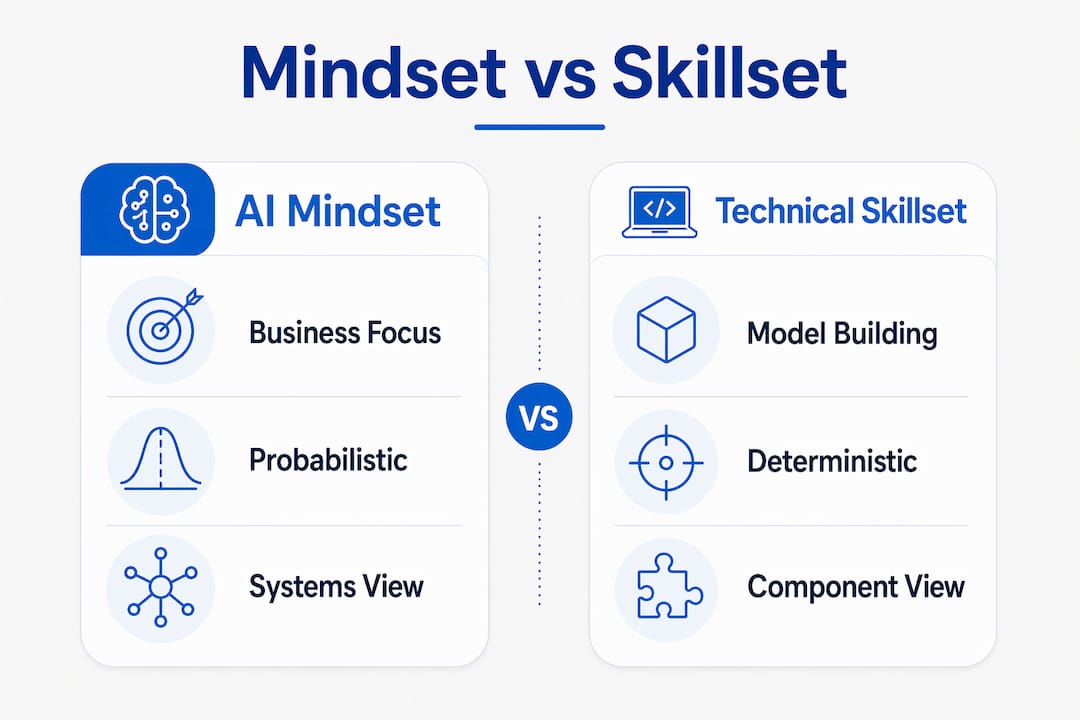
The technical view treats AI as a model to build and deploy. The mindset view treats AI as a living system to monitor, adapt, and align with business goals. Coding represents roughly 10% of the effort in a real machine learning project. The remaining 90% goes to operational safety nets, documentation, monitoring, and failure handling. That ratio reveals where the real work lives.
A mindset-driven professional asks: "Does this system behave reliably in production?" A skillset-driven professional asks: "Does this model score well on the benchmark?" Those are different questions with different consequences.
| Dimension | Mindset-driven approach | Skillset-driven approach |
|---|---|---|
| Primary focus | Business outcomes and system reliability | Model accuracy and technical performance |
| Response to failure | Treat as data, iterate fast | Diagnose as a technical error to fix |
| AI role | Probabilistic collaborator | Deterministic tool |
| Success metric | Demonstrated business value | Model benchmark scores |
| Workflow orientation | System-centric, full pipeline | Model-centric, isolated component |
Pro Tip: Before you touch a model, write down the business problem in one sentence and the metric that proves you solved it. If you cannot do that, you are not ready to build.
How do you cultivate an AI mindset in practice?
Developing artificial intelligence thinking is a deliberate practice, not a passive outcome of using AI tools more often. The strategies below are ordered by where they have the most impact.
-
Start with the business hypothesis, not the technology. Define your baseline metrics before writing a single line of code or crafting a single prompt. A problem-first approach keeps AI anchored to real value instead of impressive demos.
-
Solve the problem independently first, then bring in AI. Research from Science News shows that using AI after an initial independent effort improves both critical thinking and memory retention. Early reliance on AI skips the cognitive work that builds judgment.
-
Run small experiments, not big deployments. Treat each AI interaction as a test with a hypothesis, a result, and a lesson. Document what changed between attempts. This is the Bayesian approach in practice: updating beliefs as new evidence arrives.
-
Build operational safety nets before you scale. Monitoring, fallback logic, and clear documentation are not optional extras. They are the product. An unexplainable model is a liability regardless of its accuracy.
-
Practice trade-off thinking daily. An AI engineer balances accuracy, speed, cost, and user experience rather than chasing a perfect model. Apply that same logic to every AI decision you make, whether you are a developer or an executive.
-
Develop your observation skills. The professionals who get the most from AI are those who notice what the output almost said, not just what it said. That gap is where insight lives.
Pro Tip: Keep a short log of your AI experiments. Note the hypothesis, the output, and what you changed. After two weeks, patterns emerge that no single session reveals.
What pitfalls should you avoid when adopting an AI mindset?
The most common mistake is treating AI adoption as a tool acquisition problem. Professionals buy subscriptions, attend demos, and add AI features to their workflow without changing how they think. The tools change. The results do not.
Watch for these specific traps:
- Overreliance before independent effort. Early AI dependence reduces critical thinking. Use AI as a second opinion, not a first draft of your thinking.
- Expecting exact, step-by-step answers. AI operates probabilistically. Demanding certainty from a system built on probability leads to frustration and misuse.
- Treating outputs as final truth. Every AI output is an input for your next decision. Stop the process there and you have outsourced your judgment.
- Ignoring system operationalization. Building a model and deploying a system are two different things. Most AI projects fail after deployment, not before it.
- Skipping documentation. Unexplainable models are business liabilities. If you cannot explain why your AI made a decision, you cannot defend it to a client, a regulator, or yourself.
- Measuring success by tool sophistication. The most advanced AI setup is not the most valuable one. The most valuable one solves a real problem reliably.
Pro Tip: Run a "pre-mortem" before any AI project. Ask: if this fails in six months, what will have caused it? The answers almost always point to mindset gaps, not technical ones.
Key Takeaways
Developing an AI mindset means adopting probabilistic, entrepreneurial thinking that treats AI as a living system requiring judgment, iteration, and continuous adaptation to deliver real business value.
| Point | Details |
|---|---|
| Mindset over skillset | Rethinking workflows for 3x gains matters more than incremental reskilling. |
| Probabilistic thinking | Treat every AI output as a hypothesis to test, not a conclusion to accept. |
| System-centric focus | Coding is roughly 10% of AI work; monitoring and reliability are the rest. |
| Timed AI use | Solving problems independently before using AI protects critical thinking. |
| Documentation as defense | Unexplainable models are liabilities; clear documentation is a business requirement. |
Why the AI mindset is the only edge that compounds
Most professionals I observe treat AI adoption as a sprint. They learn a tool, get a productivity bump, and move on. The professionals who build lasting advantages treat it as a practice, something they refine continuously the way a surgeon refines technique or an investor refines judgment.
The insight that changed how I think about this came from watching ML engineers stall. The ones who plateaued were technically skilled. They could build models. What they could not do was connect those models to demonstrated business value. That is a mindset failure, not a skills gap.
Embracing failure as data is not a motivational slogan. It is a technical requirement. Every iteration that does not work narrows the space of what will. Professionals who internalize that logic move faster than those who treat each failure as a setback.
The AI mindset also demands that you protect your own cognition. Outsourcing your first effort to AI is the cognitive equivalent of outsourcing your workouts. You get the appearance of progress without the underlying capacity. The strongest AI users I have seen are the ones who think hardest before they prompt.
Finally, this mindset is not a destination. AI systems evolve, business contexts shift, and what worked last quarter may not work this quarter. The professionals who sustain their edge are those who stay curious, document what they learn, and update their approach the way a good scientist updates a theory.
— A
How Meetmira supports your AI mindset development
Building an AI mindset is not purely an intellectual exercise. It requires working through the unconscious patterns that make you default to certainty-seeking, avoid experimentation, or distrust your own judgment when AI outputs conflict with your instincts.
Meetmira's MIRA is an AI Consciousness Trainer and Mindset App built specifically for professionals and entrepreneurs who want to develop the inner capacity to work with AI as true creators. MIRA guides you through conscious exercises that strengthen probabilistic thinking, sharpen judgment, and dissolve the mental blocks that keep you reactive rather than deliberate. If you are ready to move from passive AI user to confident AI thinker, start with MIRA and build the foundation that makes every tool you use more effective.
FAQ
What is an AI mindset in simple terms?
An AI mindset is the habit of treating AI outputs as hypotheses to test rather than answers to accept. It combines probabilistic thinking, entrepreneurial adaptability, and strong judgment to get real value from artificial intelligence.
Is coding required to develop an AI mindset?
Coding is not required. Machine learning projects spend roughly 90% of their effort on system reliability, monitoring, and documentation, not writing code. The mindset matters far more than the technical skill.
How does an AI mindset improve decision-making?
It shifts decision-making from seeking certainty to improving odds. Bayesian thinking means updating your beliefs as new evidence arrives, which makes each AI-assisted decision more accurate over time.
Can overusing AI hurt your thinking?
Yes. Research shows that relying on AI before attempting a problem independently reduces critical thinking and memory retention. The fix is to solve first, then use AI as a collaborator.
How long does it take to develop an AI mindset?
There is no fixed timeline. The mindset develops through deliberate practice: running small experiments, documenting results, and updating your approach based on what you learn. Consistent iteration over weeks produces measurable shifts in how you work with AI.